
This blog post summarizes an article published in issue 137 of the French journal Revues Internationales, available on Cairn (the issue is in French). It is intended to be shorter and more accessible to readers who may not be specialists in the U.S. political system, and provides context regarding the institutional environment. It is also the only available English version of this paper. If you are a French speaker, I obviously encourage you to read the full article on Cairn, which remains highly accessible, even though it is longer, more in-depth, and less contextualized (since it is aimed at an audience already familiar with U.S. institutions). Please cite the Cairn article directly rather than this post, if necessary.
This blog post is also available in French.
On November 3, 2026, US voters will have their say on how the second half of Trump’s term unfolds. These midterm elections, as is customary, will renew (among other things) one-third of the 100 senators and all 435 members of the House of Representatives in Congress. This election is being closely watched by virtually all citizens and media outlets, and for good reason: while a shift in control of the House of Representatives (the lower chamber of Congress) — which currently supports the Republican president — is very likely, the possibility of a Democratic majority in the Senate, though more difficult to achieve, does not seem out of reach.
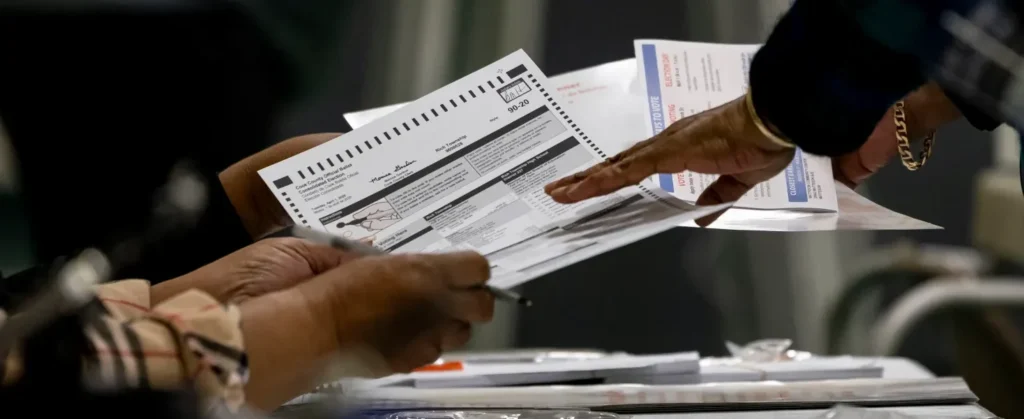
Who are people voting for? Why?
The Senate, the upper chamber of Congress, does indeed wield significant legislative power (including the authority to confirm impeachment). It is well known to all observers that midterm elections generally go against the sitting president in the House of Representatives, with an average loss of 26 seats per midterm election over the past 50 years. However, this is not necessarily the case for the Senate, where only one-third of the seats are up for election, and where the composition of the states up for election largely determines the likelihood of a majority within the chamber. The prospect of the Senate swinging to the Democratic side is therefore a legitimate cause for concern for the current administration.
However, it would be a mistake to think that midterm elections only renew federal legislative bodies. In fact, they also involve the election of various representative offices. At the state level, the governor (the executive) is up for re-election, as are the attorney general and the secretary of state (who is responsible for organizing elections). These elections also involve the renewal of representatives in each state’s legislature (State Senate and State House), who, just like their federal counterparts, vote on state-specific laws. Depending on local circumstances, mayors, sheriffs (local police chiefs), and school boards are also up for election.
Finally, aside from representative elections this time, there is a significant element of direct democracy: referendums (ballot measures).
The Principle of Referendums in the United States
Referendums can take place at various levels (city, county, state), but never at the federal level. The most widely covered are, of course, state-level referendums, which naturally affect a larger number of people. It is important to note, however, that not all states follow the same rules: while all states occasionally seek citizens’ input through referendums, only 26 out of 50 allow citizens themselves to submit their own referendum initiatives.
There are generally three types of referendum initiatives:
- Constitutional amendments: Citizens propose to directly amend their state’s constitution (e.g., abortion, voting procedures, etc.).
- Laws and statutes: Citizens can propose a new ordinary law (e.g., legalization of cannabis, increase in the minimum wage, environmental protection).
- Popular veto: Citizens can collect signatures to block or repeal a law that has just been passed by the local legislature (e.g., blocking a tax, rejecting a law on school organization).
This system of direct democracy is primarily a reality in the Western States: in fact, states such as California, Oregon, Colorado, and Arizona are among those that submit the most proposals to their voters.
Many of these instances of direct democracy allow for greater granularity in legislation and also provide a counterbalance to government power through citizen participation. However, it is not a perfect, magical, or flawless solution: direct democracy remains a democratic tool like any other, one that does not solve every problem, and it is important to be aware of its limitations (which are beyond the scope of this post). A literature review (in English) by Simsek et al. provides an excellent overview of the advantages and disadvantages of direct democracy, and I highly recommend it to anyone who would like to develop a better understanding of the issues involved.
How are referendums being used under Trump II?
Under Trump’s second term, referendums have taken on a unique role.
In fact, during the 2024 presidential election, many voters who voted for Donald Trump also supported measures that ran counter to his policies. Abortion is the clearest example: of eleven measures related to reproductive rights, ten aimed to protect or expand access to abortion, and seven were passed. Among them, Missouri, Montana, Arizona, and Nevada simultaneously gave a majority of votes for the Republican candidate and constitutional protection for abortion. Similarly, Missouri and Alaska (both conservative states) voted to raise the minimum wage and expand paid sick leave, while Nebraska voted in favor of paid sick leave.
However, it’s important to note that referendums are not automatically a progressive choice: California narrowly rejected an $18 minimum wage, and Massachusetts refused to bring the wages of tipped workers up to the minimum wage (even though these are two progressive states that gave Harris a majority in the 2024 presidential election).
There are potentially three explanations for this:
- Issue-based depolarization: Certain policies (especially economic ones) enjoy majority support even among Trump voters.
- The gap between partisan identity and preference: The presidential vote is driven by partisan affiliation, the most stable factor in electoral behavior, while the referendum vote reflects an opinion on a specific piece of legislation (whether its orientation is progressive or conservative).
- Campaigns for the amendment that are deliberately nonpartisan are being supported by conservative networks, which then make it possible for conservative voters to support a progressive measure.
There is also an institutional dimension: the referendum mechanism itself erases the direct partisan link between the referendum proposal and the parties. Indeed, voters see neither “Republican” nor “Democrat” at the time of voting, and the issue at hand appears isolated from partisan conflicts.
The Referendum as a Battleground
The democratic space opened up by direct democracy worries some elected officials, who then seek less to win the vote than to change the rules. Ohio in 2023 sets a precedent: voters in the Republican-leaning state were called to the polls in the summer (an unusual occurrence in the United States, where elections are typically held in November, resulting in a very low voter turnout) in order to raise the threshold for passing citizens’ referendums to 60 percent. The secretary of state acknowledged that the measure was intended to prevent the right to abortion from being enshrined in the Ohio Constitution. Voters rejected the conservative maneuver and then passed the amendment preserving the right to abortion three months later.
Since then, the movement has gained momentum. In 2025, state legislatures passed 72 laws on direct democracy—the highest total since at least 2017 and more than double the 2018–2024 average (approximately 35). A few examples:
- Missouri: partial repeal of Proposition A on the minimum wage and paid sick leave, followed by the placement on the 2026 ballot of an amendment that would repeal the right to abortion passed in 2024. A proposal requiring a majority in each of the eight congressional districts is also under consideration—a measure unprecedented in the country.
- Utah: A more burdensome process, and a proposed 60% threshold for certain tax-related initiatives.
- Florida: A 2025 law shortened the deadlines for collecting signatures, required the registration of signature collectors, and tightened verification procedures. In 2026, no citizens’ initiative on the ballot qualified for the election (which had never happened since ballot initiatives were introduced in Florida in 1968). A federal court upheld the law’s legality.
Why interfering with referendums?
Restrictions are often justified by serious arguments: the integrity of the democratic process, the influence of outside funding, cost control, and the requirement for broad geographic support to amend a constitution. However, their practical effect is the same: raising the cost, the time required, and the threshold for an initiative reduces its use, especially for citizen-led campaigns, which have fewer resources than professional institutional actors (such as lobbying groups).
This does not prove a coordinated strategy at the national level, even if pressure from federal and state authorities may suggest some partisan coordination. The Ballot Initiative Strategy Center, an organization that supports citizen initiatives, refers to this as “competitive authoritarianism”: the government allows a vote to proceed as long as it does not threaten the status quo.
Is there a partisan divide?
As mentioned earlier, the tightening of laws governing citizens’ initiatives’ access to the ballot particularly affects Republican-led states. Within these states, Republican support for these measures averages 90 percent, compared to 6 percent among Democrats. This is therefore an almost exclusively conservative phenomenon—and an ambiguous one at that.
That doesn’t stop Democrats from using referendums: both sides resort to them, but in different ways. In 2026, five measures restricting the rights of transgender people will be put to a vote—in Missouri and Arizona (via legislative referral) as well as in Colorado and Washington State, two states that vote Democratic. Six amendments requiring proof of citizenship to vote are also on the ballot in more conservative states. On the left, Virginia is putting three amendments to the ballot on reproductive rights, marriage equality, and the restoration of voting rights after a criminal conviction, while California is proposing a one-time tax on extremely large estates.
These measures are sometimes used as electoral magnets: Nevada’s governor presented a measure on the role of transgender people in women’s sports as a “vote getter” for his reelection. The goal is to mobilize divisive issues that attract voters supportive of the governor.
Are all referendum measures equal?
At the risk of sounding normative, no.
After this seemingly provocative answer, it is worth explaining what is meant here: there is no one measure that is “better” than another. However, from a qualitative standpoint, it would be incorrect to claim that all referendum measures have the same impact on the democratic system.
A vote on a referendum measure aimed at changing a law can be reconsidered, even if it fails. However, a vote that changes the rules of direct democracy by making it less accessible makes any future use of the citizens’ initiative permanently more difficult, regardless of political affiliation. Since the tightening of conditions for access to direct democracy is observed primarily in conservative states, the conflict over the rules prolongs the partisan conflict through other means.
This situation can be interpreted in two ways: direct democracy can serve as a safety valve that gives voice to what polarization suffocates, or as a battlefield where the question of who decides is played out. Under Trump’s second term, the two coincide. The results of the 2026 midterms will reveal, at the very least, which way the status quo is leaning.
Cited works from the Cairn article
Find the article in the issue 137 of Recherches Internationales.
Aldrete, Isabella. 2026. “Lombardo Touted Women’s Sports Measure as ‘Vote Getter’ That Could Help His Re-Election.” The Nevada Independent. https://thenevadaindependent.com/article/lombardo-touted-womens-sports-measure-as-vote-getter-that-could-help-his-re-election.
Ballot Initiative Strategy Center. 2026a. BISC Report: Attacks on the Ballot Measure Process. https://ballot.org/dd-threats-report-2026/.
Ballot Initiative Strategy Center. 2026b. “What You Need to Know About the Ballot Measure Landscape Right Now.” https://ballot.org/the-hot-sheet/.
Ballotpedia. 2023. “Ohio Issue 1, 60% Vote Requirement to Approve Constitutional Amendments Measure (2023).” https://ballotpedia.org/Ohio_Issue_1,_60%25_Vote_Requirement_to_Approve_Constitutional_Amendments_Measure_(2023).
Ballotpedia. 2024. “Results for Abortion-Related Ballot Measures, 2024; Results for Minimum Wage and Labor-Related Ballot Measures, 2024.” https://ballotpedia.org/Results_for_abortion-related_ballot_measures,_2024.
Ballotpedia. 2025a. “2025 Ballot Measures.” https://ballotpedia.org/2025_ballot_measures.
Ballotpedia. 2025b. “Analysis of 2025 Changes to Laws Governing Ballot Measures.” https://ballotpedia.org/Analysis_of_2025_changes_to_laws_governing_ballot_measures.
Ballotpedia (Ballotpedia News). 2025c. “State Lawmakers Enacted 72 Bills on Ballot Measures and Direct Democracy in 2025, the Highest Total since at Least 2017.” August 21. https://news.ballotpedia.org/2025/08/21/state-lawmakers-enacted-72-bills-on-ballot-measures-and-direct-democracy-in-2025-the-highest-total-since-at-least-2017/.
Ballotpedia. 2026. “2026 Ballot Measures.” https://ballotpedia.org/2026_ballot_measures.
Bannon, Alicia. 2024. “What We Learned From State Ballot Measures.” State Court Report, Brennan Center for Justice, November 15. https://statecourtreport.org/our-work/analysis-opinion/what-we-learned-state-ballot-measures.
Bartels, Larry M. 2000. “Partisanship and Voting Behavior, 1952-1996.” American Journal of Political Science 44 (1): 35–50.
Benz, Jennifer, and Trevor Tompson. 2025. “AP VoteCast 2024 General Election.” In AP VoteCast. AP-NORC Center for Public Affairs Research, March. https://apnorc.org/projects/ap-votecast-2024-general-election.
Campbell, Angus, Philip E. Converse, Warren E. Miller, and Donald E. Stokes. 1960. The American Voter. John Wiley & Sons.
Donovan, Todd, Caroline J. Tolbert, and Daniel A. Smith. 2008. “Priming Presidential Votes by Direct Democracy.” The Journal of Politics 70 (4): 1217–31.
Florida Department of State. 2026. “Note to Press: 2026 Constitutional Amendment Petition Campaigns.” February 1. https://dos.fl.gov/communications/press-releases/2026/note-to-press-2026-constitutional-amendment-petition-campaigns/.
Gerber, Elisabeth R. 1999. The Populist Paradox: Interest Group Influence and the Promise of Direct Legislation. Princeton University Press.
Harvard Law Review Note. 2025. “Putting the Initiative Back Together.” Harvard Law Review 138 (7): 1911–55.
Ingles, Jo, and Karen Kasler. 2023. “Ohio Voters Reject Issue 1, Keeping the Bar for Constitutional Amendments at a Simple Majority.” NPR, August 8. https://www.npr.org/2023/08/08/1191679261/.
KFF. 2024. The Role Health Care Issues Played in the 2024 Election: An Analysis of AP VoteCast. KFF. https://www.kff.org/womens-health-policy/the-role-health-care-issues-played-in-the-2024-election-an-analysis-of-ap-votecast/.
League of Women Voters. 2026. “Florida Decides Healthcare v. Byrd.” https://www.lwv.org/legal-center/florida-decides-healthcare-v-byrd.
Levitsky, Steven, and Lucan A. Way. 2010. Competitive Authoritarianism: Hybrid Regimes after the Cold War. Cambridge University Press.
Lupia, Arthur. 1994. “Shortcuts Versus Encyclopedias: Information and Voting Behavior in California Insurance Reform Elections.” American Political Science Review 88 (1): 63–76. https://doi.org/10.2307/2944882.
Matsusaka, John G. 2020. Let the People Rule: How Direct Democracy Can Meet the Populist Challenge. Princeton University Press.
McKellar, Katie. 2025. “Ballot Initiatives in Utah Face More Requirements After Gov. Cox Signs SB 73.” Utah News Dispatch, March 26. https://utahnewsdispatch.com/2025/03/26/ballot-initiatives-utah-more-requirements-gov-spencer-cox-sb73/.
NBC4i (WCMH). 2023. “Issue 1 Is ‘100%’ About Blocking Abortion Measure, Frank LaRose Says.” https://www.nbc4i.com/news/local-news/issue-1-is-100-about-blocking-abortion-measure-frank-larose-says/.
Scott v. McDougle, Record No. 260127 (Supreme Court of Virginia May 8, 2026). https://www.vacourts.gov/static/opinions/opnscvwp/1260127.pdf.
Seifter, Miriam. 2021. “Countermajoritarian Legislatures.” Columbia Law Review 121 (6): 1733–98.
Strano, Maresa. 2025. A Case for (Responsibly) Expanding Citizen-Led Policymaking in the United States. New America. https://www.newamerica.org/political-reform/briefs/a-case-for-responsibly-expanding-citizen-led-policymaking-in-the-united-states/.
Tolbert, Caroline J., and Daniel A. Smith. 2005. “The Educative Effects of Ballot Initiatives on Voter Turnout.” American Politics Research 33 (2): 283–309.